Showing posts with label incense making. Show all posts
2/15/2010
Making non-combustible incense
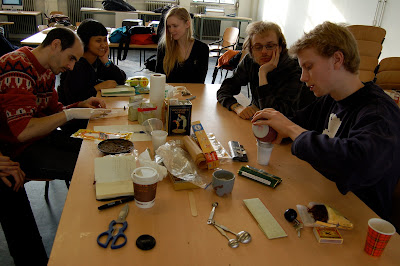
Here you can see some pictures of our last weekend experiment, making non-combustible incense for coming presentations.
Juan and Pablo.
Juan and Pablo.
2/13/2010
DAY 6: how to make non-combustible incense (Neriko)
non-combustible incense (kneaded incense / Neriko)
- Mix all the aromatic properties well in a mortar
- Add a bit of charcoal powder (for a disinfectant property)
- Add clover honey (for a gluing property)
- Make incense cookies. The thinner the faster it will dry, and the faster it will diffuse smell when it's burned or warmed
- Dry them at a dark, cold place for a couple of days to a week. In Japan they even take additional efforts to ripe them: they put them in a clay-jar and bury it in the ground and let them naturally matured for a half year.
- Burn Neriko and check its proper temperature for diffusing the desired smell. (Each material has its own character)
Labels:
[helpful info],
[progress],
incense making,
workshop
DAY 6: how to make combustible incense
Combustible incense
[proportion]
(1) When you use resin or oily substances (as an aromatic property) , add 25 -80 % makko to the content.
*What's makko?
Powdered bark of Illicium anisatum
http://en.wikipedia.org/wiki/Illicium_anisatum
The resin or oily substances should not exceed the amount of dried materials. The less, the easier it will burn. To make a balance, you can use the following materials as 'dried materials'
(2) When you use no resin or oily substances (as an aromatic property) , add 10 - 25 % makko to the content.
example recipe 1
[order]
[shape and texture]
cone: dough-like texture
stick: oatmeal texture
[proportion]
(1) When you use resin or oily substances (as an aromatic property) , add 25 -80 % makko to the content.
*What's makko?
Powdered bark of Illicium anisatum
http://en.wikipedia.org/wiki/Illicium_anisatum
The powder has conbustible property as well as gluing property
The resin or oily substances should not exceed the amount of dried materials. The less, the easier it will burn. To make a balance, you can use the following materials as 'dried materials'
- wood (powdered)
- bark (powdered)
- leaf (powdered)
(2) When you use no resin or oily substances (as an aromatic property) , add 10 - 25 % makko to the content.
example recipe 1
- 4 tablespoon cinnamon powder
- 1/2 to 1 tablespoon makko
- 1 part sandalwood powder
- 1/2 part clove powder
- 2 parts makko
[order]
- mix the aromatic ingredients well in a mortar
- add makko
- add water gradually and bring it to the desired texture
[shape and texture]
cone: dough-like texture
stick: oatmeal texture
Labels:
[helpful info],
[progress],
incense making,
workshop
2/12/2010
DAY 6: workshop - incense making
Making conbustible incense (1)
aromatic material: fermented coconut ??? (by Pablo and Juan)
It smells like sheep cheese.
1 teaspoon fermented coconut
1/2 teaspoon makko
1/4 teaspoon charcoal powder (ground Japanese charcoal)
Making conbustible incense (2)
aromatic material: tobbac (by Willem)
Making non-combustible incense (Neriko)
aromatic material: violet tea (by Yerry)
1 teaspoon violet tea
1/2 teaspoon honey + more
They are all 'binder' for making Neriko.
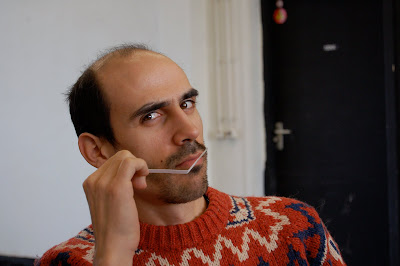
Checking the smell of non-combustible incense made by Yerry
It smelled like bitter black tea, not quite like violet tea. So I've measured the temperature, then it turned out to be too high: 200 degrees!
So I've lowered internal temperature of the burner to 80 degrees ---> smelled more 'sweet' than just bitter black tea
Sharing Willem's project in development.
Checking extracted smells.
Labels:
[progress],
incense making,
smell extraction,
workshop
2/10/2010
Where to get pocket warmer
Information for Pablo and Huan.
'Heat Pad' is something that is used normally for keeping hands warm. There are different types - one keeps 40 degrees and the other keeps 70 degrees. You can use them for diffusing smells in one way or the others.
Bever Zwerfsport (also in Den Haag Centrum)
Pocket warmer
http://www.bever.nl/wintersport/accessoires/4477.rubytec-pocket-warmer
Heat pad
http://www.bever.nl/wintersport/accessoires/4475.rubytec-heat-pad
Info about incence making - what to prepare
Hi everyone,
On Thursday we'll have [how to make incense] workshop. We'll make 2 types of incense:
- Charcoal based cone incense (combustible incense)
- Neriko - Japanese kneaded incense (non-combustible incense)
You can bring your preferred smelly materials for the workshop. They should be dried and powdered already. How much to prepare actually depends on the materials, but let's say something like 2 to 4 table spoon (powdered). Please remember that the raw materials should be fragrant enough. There is a limitation to the numbers of mortars, so let's see how we organize it - we'll perhaps give priority to the students who have materials directly connected to the mini-project.
If you want to know more about the possibilities of incense and incense making, these are good resources.
General info about incense
http://en.wikipedia.org/wiki/Incense
How to make incense
http://www.scents-of-earth.com/makyourownna.html
How to make incense - ehow
http://www.ehow.com/how_7540_make-incense.html
How to make incense sticks
http://sjamaanopklompen.com/frameset_uk_bamboe.htm
http://www.instructables.com/id/How-to-make-Incense-sticks/
If you want to continue with oil/vodka extraction on Thursday, that's also fine.
Please feel free to call me 06-54 65 80 54 for any questions.
See you on Thu.!
Maki
Labels:
[helpful info],
[progress],
incense making,
websites
Subscribe to:
Posts (Atom)